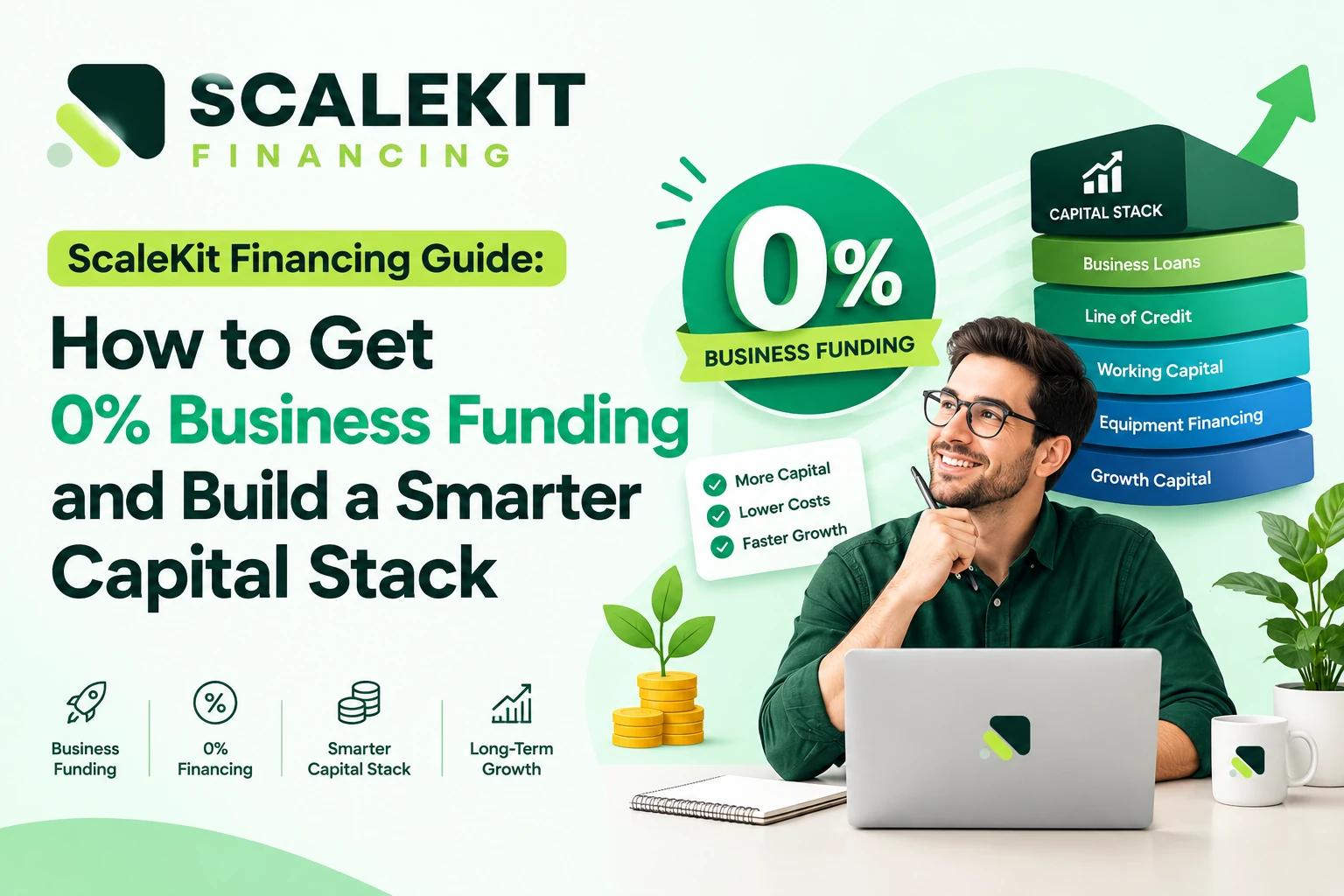
Getting approved for business funding used to mean picking one lender, filling out one application, and hoping for the best. That approach rarely surfaces the best available terms, because no single lender covers every financing scenario. A growing number of business owners are now using financing platforms like ScaleKit Financing to compare multiple funding paths through one process instead of applying blind to individual banks.
This guide breaks down how modern business financing works, what funding types exist, and how to evaluate which one actually fits your business — not just which one approves you fastest.
Why a single-lender approach falls short
Every lender has a narrow underwriting box: specific revenue thresholds, time-in-business requirements, credit score cutoffs, and industry preferences. A business that gets rejected by one bank might easily qualify with another lender that specializes in its exact profile. The problem is discovery — most business owners don't know which of the hundreds of financing providers in the market would actually say yes.
This is the gap that lending marketplaces are built to close. Instead of a business owner applying to lender after lender, a platform reviews one profile and maps it against a wider network. ScaleKit Financing, for example, connects businesses to financing options across a network of 200+ lenders, using a single intake process to surface multiple potential paths at once.
Core types of business funding you should know
Before comparing providers, it helps to understand the main categories of financing available to business owners in the US market:
- Small business loans — General-purpose financing for established businesses with a proven revenue history, typically used for expansion, hiring, or operations.
- SBA loans — Longer-term, government-backed loans for qualified businesses, often offering lower rates but requiring more extensive documentation and a longer approval timeline.
- Lines of credit — Reusable capital that a business can draw from as needed and repay only on the amount used, ideal for managing recurring or unpredictable cash flow gaps.
- Term loans — A lump sum repaid on a fixed schedule, best suited for defined, one-time investments like equipment purchases or facility upgrades.
- Working capital loans — Short-term funding designed to keep payroll, vendor payments, and day-to-day operations running while revenue catches up.
- E-commerce funding — Financing tailored to online sellers, often used to cover inventory purchases, ad spend, and seasonal demand spikes.
- Revenue-based financing — Repayment tied to a percentage of ongoing revenue rather than a fixed monthly payment, useful for businesses with variable income.
- Startup loans — Capital routes designed for newer companies that may not yet meet the time-in-business requirements of traditional lenders.
What is credit stacking?
One financing strategy gaining traction among qualified founders is credit stacking — sequencing multiple introductory 0% APR business credit products together to build a larger pool of usable capital. Done correctly, this can preserve cash flow during the promotional interest-free period and give a business access to a combined credit line larger than what any single institution would offer alone.
Credit stacking isn't a fit for every business. It works best for founders with a strong personal and business credit profile who have a specific, revenue-producing use for the capital — not open-ended spending. Because timing, utilization, and application order matter significantly, this strategy is generally approached with structured guidance rather than done alone.
How to evaluate which funding path fits
Rather than chasing the largest approval amount, business owners get better outcomes by matching the funding type to the actual use case:
| Need | Best-fit option | What lenders look at |
|---|---|---|
| Recurring or uncertain expenses | Line of credit | Revenue, time in business, credit |
| One-time, defined investment | Term loan | Cash flow, operating history |
| Fast-moving operational needs | Revenue-based financing | Consistent business deposits |
| Building a larger capital pool | Credit stacking | Personal + business credit profile |
This framework matters because the “best” loan is not universal — it depends entirely on what the capital needs to accomplish and how quickly it needs to be repaid.
What to prepare before applying
Regardless of which financing path you pursue, most lenders and platforms will ask for a similar core set of documents:
- Recent business bank statements
- Government-issued identification
- Business entity or formation documents
- Basic revenue and cash flow information
Having these ready before starting an application shortens the review process significantly. On platforms like ScaleKit Financing, funding decisions typically take around 14 days on average once a complete profile is submitted, though actual timelines vary by lender, product, and applicant qualifications.
Common questions about business funding platforms
Is a financing platform the same as a lender?
No. Platforms like ScaleKit Financing are not lenders themselves — they connect qualified businesses with financing options from a network of third-party lenders and help evaluate which options are the best fit.
Does checking eligibility hurt your credit score?
An initial eligibility review is generally designed to surface potential options without a hard credit pull. However, some lenders may require a hard inquiry later in their own approval process, and a transparent platform will disclose this before it happens.
How much funding can a business typically qualify for?
This depends on multiple factors: monthly revenue, time in business, credit profile, industry, and the specific financing product being requested. There is no fixed number — qualification is applicant-specific.
The bottom line
Business funding decisions carry real consequences for cash flow, repayment obligations, and growth timelines. Instead of applying to one lender at a time and hoping for approval, comparing multiple financing paths through a single, structured process — the model platforms like ScaleKit Financing are built around — gives business owners a clearer picture of what's actually available before committing to any one option.
The right funding isn't always the one with the highest approval amount. It's the one structured around what the capital is actually meant to accomplish.
This article is for general informational purposes and does not constitute financial advice. Funding availability, terms, and qualification criteria vary by lender and applicant. ScaleKit Financing is not a lender; it connects businesses with third-party financing providers, and all financing is subject to lender approval and underwriting.